
What are the main aspects of the ISO 9000:2026 (EN) standard certification?
1、Basic Introduction
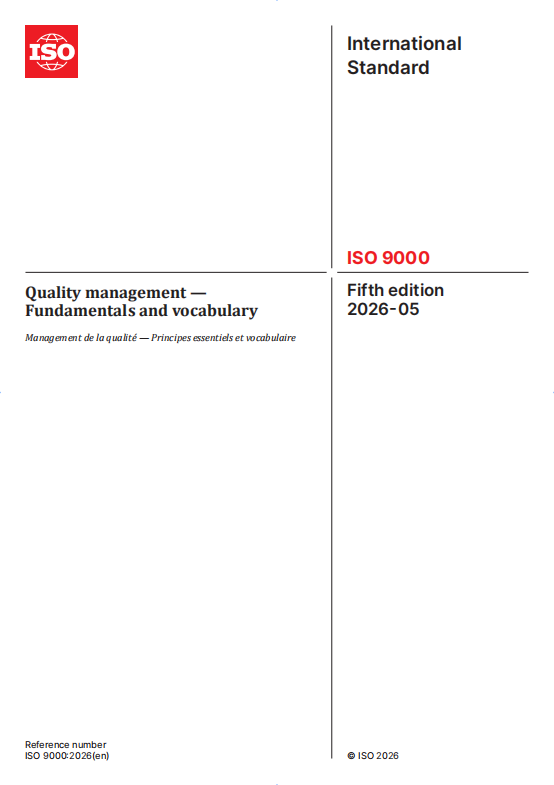
Released in May 2026 as the 5th edition, ISO 9000:2026 fully supersedes the old ISO 9000:2015. It acts as the foundational guide and unified glossary for the entire ISO 9000 standards family. Companies cannot obtain certification solely against this document; any business seeking ISO 9001:2026 certification must follow the definitions and core concepts laid out in this standard.
The official title has been streamlined by removing the phrase “systems”. Its coverage expands from basic quality management system fundamentals to organization-wide quality management rules, covering corporate strategy, digital transformation, green production, supply chain operation and risk control scenarios.
2、Standard Chapter Layout
Clause 1: Scope
- Enterprises looking to build stable quality management systems and achieve long-term steady operation
- Buyers hoping to secure consistent qualified goods and services from suppliers
- Upstream and downstream vendors, regulators, staff and other relevant stakeholders
Clause 2: Normative References
Clause 3: Terms and Definitions (the glossary core of the whole standard)
- Scale upgrade: Total defined terms rise from 146 under the 2015 version to 184, with 38 new entries covering digital operations, eco-friendly production, risk control and supply chain management.
- Classification scope: 12 major categories including organizational management, process control, system operation, customer relations, data administration, auditing standards, risk management, circular economy and digital quality control.
- Practical value: Eliminates misunderstandings caused by inconsistent wording among enterprises, auditors and clients in cross-party communication.
- Supplementary appendix: Alphabetical index of all terms for quick lookup during daily use and audit work.
Clause 4: Quality Management Fundamentals (the section with the biggest revisions)
Core Basic Quality Management Concepts
These lay the underlying framework and work alongside the seven core quality management principles:
Quality, quality management, quality management system, process approach, PDCA cycle, risk-based thinking (promoted to a top-tier core concept in this update).
Newly Added Targeted Concepts to Match Current Industry Trends
- Circular economy: For the first time included in core quality fundamentals, covering full product lifecycle management, resource recycling and low-carbon manufacturing requirements.
- Quality control powered by emerging digital tools: Data-driven quality monitoring, digital production control, smart manufacturing, digital twin technology and automated inspection processes.
- Supply chain resilience management: Full lifecycle supplier supervision, upstream and downstream risk prevention and stable supply guarantee mechanisms.
Seven Quality Management Principles (core guiding rules, retained with updated explanatory notes)
- Customer focus
- Leadership commitment
- Engagement of people
- Process approach
- Improvement (covering both continuous incremental improvement and breakthrough transformation)
- Evidence-based decision making (stresses factual and data support for all management judgments under digital working modes)
- Relationship management (expanded to cover full supply chain networks, business partners and all interested parties)
Annex A: Concept Relationship Diagrams
Three Primary Functions of ISO 9000:2026
- Unified industry glossary: 184 globally recognized standard definitions to align professional wording across international quality management work.
- Theoretical reference material: Comprehensive elaboration of seven quality management principles and 22 modern quality control concepts for internal training and auditor learning.
- Supporting auxiliary document: Provides consistent conceptual benchmarks for ISO 9001:2026 (certification standard) and ISO 19011 (auditing standard).
| ISO 9000:2026 | ISO 9001:2026 |
|---|---|
| Foundational glossary document with no mandatory certification clauses | Official certification standard, outlining mandatory system requirements all organizations must satisfy |
| Explains core definitions and basic ideas of quality management | Details specific operational rules and compliance targets for corporate quality systems |
| Reference material for training, internal audits and auditor preparation | Mandatory benchmark for third-party certification, bidding and regulatory compliance |
Key Updates Introduced in the 2026 Version
- Risk-based thinking upgraded to a core fundamental concept, placed on an equal level with the process approach and PDCA cycle.
- Circular economy and sustainable green development formally incorporated into the core framework of quality management.
- A large batch of new terms and practical guidance related to digital operation, data quality and smart manufacturing added.
- Strengthened clauses covering supply chain risk resistance and full-lifecycle product quality oversight.
- Full structural rearrangement to align formatting with other mainstream ISO management standards, simplifying integrated system implementation (e.g., combined ISO 14001 environmental and ISO 45001 occupational health systems).
What are the main aspects of the ISO 9000:2026 (EN) standard certification?:等您坐沙发呢!